Tampilkan postingan dengan label Germany. Tampilkan semua postingan

Minggu, 28 Juli 2013

29 July 2011 - The USSF's Five-Year Plan Comes To Fruition

On 29 July 2011, the United States Soccer Federation announced the hiring of Jürgen Klinsmann as the national team's new manager.

Although a successful player with Germany, Inter, Bayern Munich, Klinsmann had served as a manager only twice before, and for brief spells. He guided the German national team to a third-place finish in the 2006 World Cup, but left that summer after only two years at the helm. He then took charge of Bayern Munich in July 2008, but left the following April after a disappointing spell.

Despite his lack of experience, the USSF had been keen to hire Klinsmann since 2006, reportedly offering him the job twice before, only to have negotiations break down when the federation would not agree to give him the broad degree of control he demanded. But after their dismissal of Bob Bradley in July 2011, they finally reached terms with Klinsmann.

His tenure started poorly, with the team losing four of their first six matches, but the situation improved by 2012, when the US enjoyed a run of success including their first-ever away win over rivals Mexico. The team continues to shine under Klinsmann, having just won the 2013 Gold Cup on the back of a team-record eleven-game winning streak.

Senin, 08 Juli 2013

9 July 2011 - Taking Hospitality A Little Too Far

On 9 July 2011, Japan eliminated 2-time defending champions and hosts Germany from the World Cup with an extra-time quarterfinal goal. They then went on the lift the cup.

The teams had met three times in previous World Cups and Germany won each one. The last two were in the group stages of the 2003 and 2007 tournaments, both of which ended with Germany as champions. As hosts of the 2011 edition, they were heavy favorites to win it a third straight time.

They breezed through the group stage with a perfect record to set up their quarterfinal meeting with Japan in Wolfsburg. It was only the second time Japan had advanced out of the first round and was as far as they had ever progressed.

The Germans controlled the early part of the match, but could not get the ball in the net despite outshooting Japan 23 to 9 on the day. Japan, meanwhile, settled in under the leadership of midfielder and captain Homare Sawa, who helped them limit Germany's chances by keeping the majority of possession.

Scoreless through 107 minutes of extra time, the day's only goal came in the 108th, as substitute forward Karina Maruyama drove the ball just inside the far post, handing Germany their first defeat in sixteen World Cup games.

Afterward, Japan beat Sweden in the semifinals, then won the final over the United States in a penalty shootout.

Kamis, 04 Juli 2013

5 July 2012 - The Times They Are A-Changin'

On 5 July 2012, the International Football Association Board, responsible for the Laws of the Game, finally approved the use of goal-line technology, reversing years of opposition.

According to the Laws of the Game, a goal is counted only when the ball passes completely over the goal line. But the fallibility of referees means that disputed goals have long been a staple of football, even reaching to the highest level. In 1966, England won the World Cup over West Germany 4-2, with their third goal still stirring controversy over whether it should have been allowed.

To address the problem, calls for the use of goal-line technology started in the 2000s, but FIFA resisted the pressure, with President Sepp Blatter saying as late as 2010 that it would be too expensive and would slow down match play.

But high-profile incidents continued to stoke public support, including a disallowed English goal against Germany in the 2010 World Cup that was far over the line (pictured) and another by Ukraine against England at Euro 2012.

Then, in July 2012, the IFAB--which consists of FIFA and the FAs of England, Scotland, Wales, and Northern Ireland--decided to allow the use of goal-line technology, starting with the 2012 Club World Cup and the 2013 Confederations Cup (although neither tournament presented an opportunity to review a decision whether to allow a goal).

At the same meeting, IFAB voted to allow women to wear headscarves while playing, reversing a rule against religious statements that had been enforced since 2007, and also voted to allow a fifth referee at matches.

Senin, 17 Juni 2013

18 June 1995 - Norway Finds The Right Combination

On 18 June 1995, Norway won the Women's World Cup with a balanced mix of overpowering offense and stifling defense.

It was the second consecutive final for the Norwegians, who lost the inaugural final to the United States in 1991. When they returned to the tournament in 1995, they quickly set the standard of quality, beating Nigeria 8-0 in their first match.They went on to win every game on their way to the final, including a 1-0 defeat of the United States in the semi-finals, conceding only a single goal and scoring a total of 21.

Their opponents in the final, Germany, had done almost as well, losing only once--a 3-2 defeat to Sweden in the group stage.

Playing at the Råsunda Stadium in Stockholm, Norway continued their demonstrate their balance, taking a 2-0 lead at the break with goals from midfielder Hege Riise (37') and forward Marianne Pettersen (pictured) (40'). It turned out to be the final margin, delivering the trophy that Norway had narrowly missed in 1991.

Since then, Norway have not finished higher than fourth, which they did in 1999 and 2007, while Germany won back-to-back trophies in 2003 and 2007.

Kamis, 09 Mei 2013

10 May 1930 - The Beginning Of A Beautiful Rivalry

On 10 May 1930, England and Germany met for the first time in a full international, playing to a 3-3 draw in Berlin.

Unofficial representative teams for the two countries played twice in 1899 with England dominating both matches, 13-2 and 10-2. Shortly afterward, England played two matches against combined German and Austrian teams and won both, 6-0 and 7-0.

But their trip to Berlin in 1930 was their first meeting since the establishment of an official German team in 1908. The game looked likely to follow the pattern of those earlier meetings when England went up 0-1 with an 8th-minute goal from Joe Bradford, but Germany's Richard Hofmann (pictured) brought the hosts level in the 21st minute.

The two traded goals again as Bradford put England back in front in the the 31st minute and Hofmann scored another equalizer eighteen minutes later. He then completed his hat-trick in the 60th minute to give Germany the lead. They held it for twenty minutes until David Jack found the net to finish the game 3-3.

Since then, the two teams have formed a fierce rivalry, including England's famously controversial win over Germany in the final of the 1966 World Cup.

Minggu, 27 Januari 2013

28 January 1900 - Clearly, It Was A Step In The Right Direction

On 28 January 1900, the German Football Association was founded in Leipzig. It went on the create one of the world's top national teams and one of the top leagues.

German football traces its origins to 1874 with the formation of the country's first club, the Dresden English Football Club. As more teams sprouted up, they coalesced into a variety of regional leagues and competitions. By 1900, many of the clubs sought to introduce a national organization, including the establishment of a national championship and a national team.

So in 1900, representatives of 86 different clubs met in Leipzig to vote on the creation of a new national association. Out of a total of 84 votes cast, the final tally was 62 in favor and 22 against and the Deutscher Fußball-Bund was born.

The DFB originally maintained the regional competitions, but consolidated them into a national title, first won by Leipzig in the 1902-03 season. Five years after that, the German national team played their first match, a 5-3 loss to Switzerland.

Since then, the national team has become one of the world's most successful, reaching the World Cup final seven times and winning it three. They have also won three European Championships. Along the way, the DFB reorganized the domestic leagues into the Bundesliga, which has become one of the world's most successful and prestigious leagues.

Rabu, 19 Desember 2012

20 December 2004 - Prinz Gets Another Crown

On 20 December 2004, German striker Birgit Prinz repeated as FIFA World Player of the Year despite having what, for her, was a down year.

She had claimed her first World Player of the Year award in 2003, after leading Germany to victory in that year's World Cup and winning a German league and cup double with Frankfurt. But in the 2003-04 season, despite a strong performance from Prinz, Frankfurt finished as runners-up in the Bundesliga and the UEFA Women's Cup. She continued to shine for the national team, scoring 14 goals in 14 matches that year, but ended 2004 without a single team trophy.

Nevertheless, she was a clear favorite for the FIFA World Player of the Year award, finishing with 376 votes, well ahead of second-place finisher Mia Hamm (286).

Prinz won the award for a third time in 2005 after taking another league title with Frankfurt and the European Championship with Germany.

Sabtu, 29 September 2012

30 September 2007 - Germany Doubles Up On Brazil

On 30 September 2007, Germany won their second consecutive Women's World Cup, beating Brazil 2-0.

In their bid to retain the trophy, the Germans started with an offensive explosion, annihilating Argentina 11-0. But then their dominant defense took over, keeping clean sheets all the way to the final. The only blemish on their campaign was a scoreless draw with England in the group stage.

The Brazilians were similarly stalwart. Though they had conceded two goals to Australia in the quarterfinals, they won every match on the way to their meeting with Germany, thanks in part to the seven goals provided by Marta, the tournament's leading scorer.

Playing at the Hongkou Stadium in Shanghai, the teams kept each other scoreless through the first half, but German forward and captain Birgit Prinz broke the deadlock with a strike in the 52nd minute. It was her fourteenth World Cup goal overall, making her the competition's all-time leading scorer.

Marta had a chance to equalize with a second-half penalty, but German keeper Nadine Angerer saved the attempt. Midfielder Simone Laudehr then cemented the victory in the 86th minute. The 2-0 scoreline was a mirror image of the men's final in 2002, when Brazil took the honors.

Prinz retired after the tournament. Marta returned in 2011 and raised her tally to fourteen to share the scoring title.

Rabu, 22 Agustus 2012

23 August 1995 - Like A Phoenix Rising From The Ashes

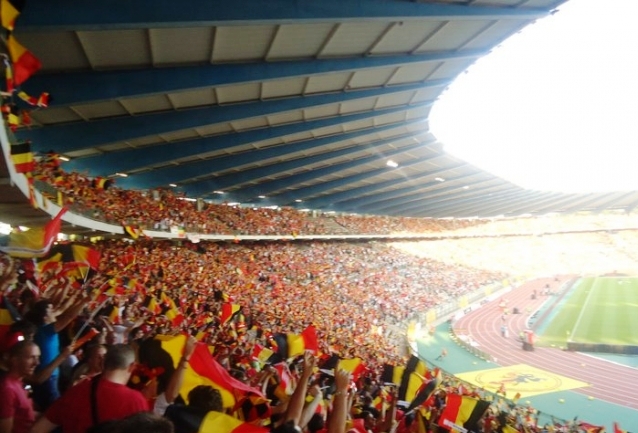
On 23 August 1995, the former Heysel Stadium hosted a football match for the first time in almost ten years, as Germany beat Belgium in a friendly.

Originally opened on 23 August 1930, the stadium was the location of one of football's greatest tragedies when it hosted the 1985 European Cup Final between Juventus and Liverpool. Approximately an hour before kick-off, a retaining wall collapsed, leaving 600 people injured and killing 39 others.

It was the last football match played at the stadium for several years, though it continued to be used for other events. By 1995, however, it had undergone a $50 million renovation and re-opened as the home of the Belgian national team.

For the first match in the new structure, renamed King Baudouin Stadium, Belgium hosted Germany in a friendly. A crowd of 33,000 watched as the Germans won 1-2 with goals from Andreas Möller (6') and Fredi Bobic (84'). Belgium's lone goal was provided by Michaël Goossens (17').

Sabtu, 07 Juli 2012

8 July 2006 - Germany Ends On A High Note (But Not The Highest Note)

On 8 July 2006, hosts Germany ended the World Cup with a win. But it was in the third-place match.

The three-time champions entered the tournament as favorites, having finished as runners-up in 2002. And they lived up to that tag as one of only four teams to win all three of their first-round matches (with Portugal, Brazil, and Spain), followed by a 2-0 win over Sweden in the Round of 16 that was more comfortable than the scoreline suggested. They advanced over Argentina on penalties in the quarterfinals, but then suffered a shocking loss to Italy in extra time to drop down to the third-place game (Italy beat them 2-0 with goals in the 119th and 120th minutes).

There, they faced Portugal, who had similarly needed penalties to get out of the quarterfinals over England, then fell to France 1-0 in the semis.

Playing before a crowd of 52,000 in Stuttgart, the two teams remained scoreless through the first half due in part to outstanding play from goalkeepers Ricardo and Oliver Kahn. It was the first appearance in the tournament for Kahn, who had been dropped as started in favor of Jens Lehmann, but got the nod over Lehmann for the third-place match, He also took over as captain in place of the injured Michael Ballack.

The Germans quickly took charge in the second half, with a brace from midfielder Bastian Schweinsteiger (pictured) (56', 78') sandwiched around an own goal from Portugal substitute midfielder Petit (60'). Portugal pulled one back with a goal from Nuno Gomes in the 88th minute and the day ended as a 3-1 win for Germany.

The match was Kahn's last international appearance, with his total of 86 caps putting him in a tie for fifteenth on Germany's all-time appearances table.

Jumat, 29 Juni 2012

30 June 2006 - Try To Calculate That Cards-Per-Minute Ratio

On 30 June 2006, Argentina left back Leandro Cufré achieved the dubious distinction of receiving a red card after a match in which he hadn't even played.

The match in question was a World Cup quarter-final, which Argentina lost to Germany on penalties, 1-1 (4-2). It had been a tense affair, with referee Ľuboš Micheľ issuing a total of seven yellow cards, four to Argentina and three to Germany. The first one--to German striker Lukas Podolski--came in just the third minute, while Micheľ showed four of them after the 88-minute mark.

After goalkeeper Jens Lehmann ended the shootout by saving the attempt from midfielder Esteban Cambiasso, the two sides clashed near the touchline. According to a BBC report, "[p]unches and kicks were thrown between both sides," but the only player to receive a card was Cufré, an unused Argentina substitute for the match. He kicked German defender Per Mertesacker in the knee to become the first player to receive a  post-match red card in World Cup history.

Afterward, FIFA fined Cufré 10,000 Swiss francs and suspended him for four matches.

Rabu, 20 Juni 2012

21 June 2002 - Germany Probably Would Have Won A Penalty Shootout, Anyway

On 21 June 2002, the United States suffered a close--and controversial--loss to Germany in the World Cup quarterfinals.

The two teams met at the Munsu Cup Stadium in Ulsan, South Korea, where a crowd of 37,337 gathered for the event. Despite entering the match as heavy underdogs, the US applied heavy pressure on the three-time World Cup champions from the opening minutes, with forwards Brian McBride and Landon Donovan both forcing early saves from keeper Oliver Kahn. The 20-year old Donovan posed a potent threat throughout the match, peppering the German goal with shots.

The Germans had a couple of early chances of their own before taking the lead with a 39th-minute header from midfielder Michael Ballack. Miroslav Klose almost added another before the break, but was denied by a brilliant save from US keeper Brad Friedel.

Shortly after the restart, the US thought they had a equalizer. A volley from center back Gregg Berhalter beat Kahn and appeared to cross the line, but struck the arm of German defender Torsten Frings and bounced back out. The US players appealed for the referee to award either a goal or a handball penalty, but were unsuccessful.

Although the Americans outshot the Germans 11 to 6 and dominated possession (58% to 42%), the Germans held on for the 1-0 victory and advanced, eventually finishing as runners-up to Brazil.